
1. Home
  2. DIY & garden guides
  3. Balcony herbs

Balcony garden guide

Balcony herbs.What to plant, month by month.

A sow-and-plant timeline from March to October for chives, parsley, basil, coriander, dill, mint, thyme, sage and rosemary, plus a starter-kit checklist and a frost note for colder climates.

  • 9 herbs
  • Mar to Oct
  • Listings checked 29 Nov 2026
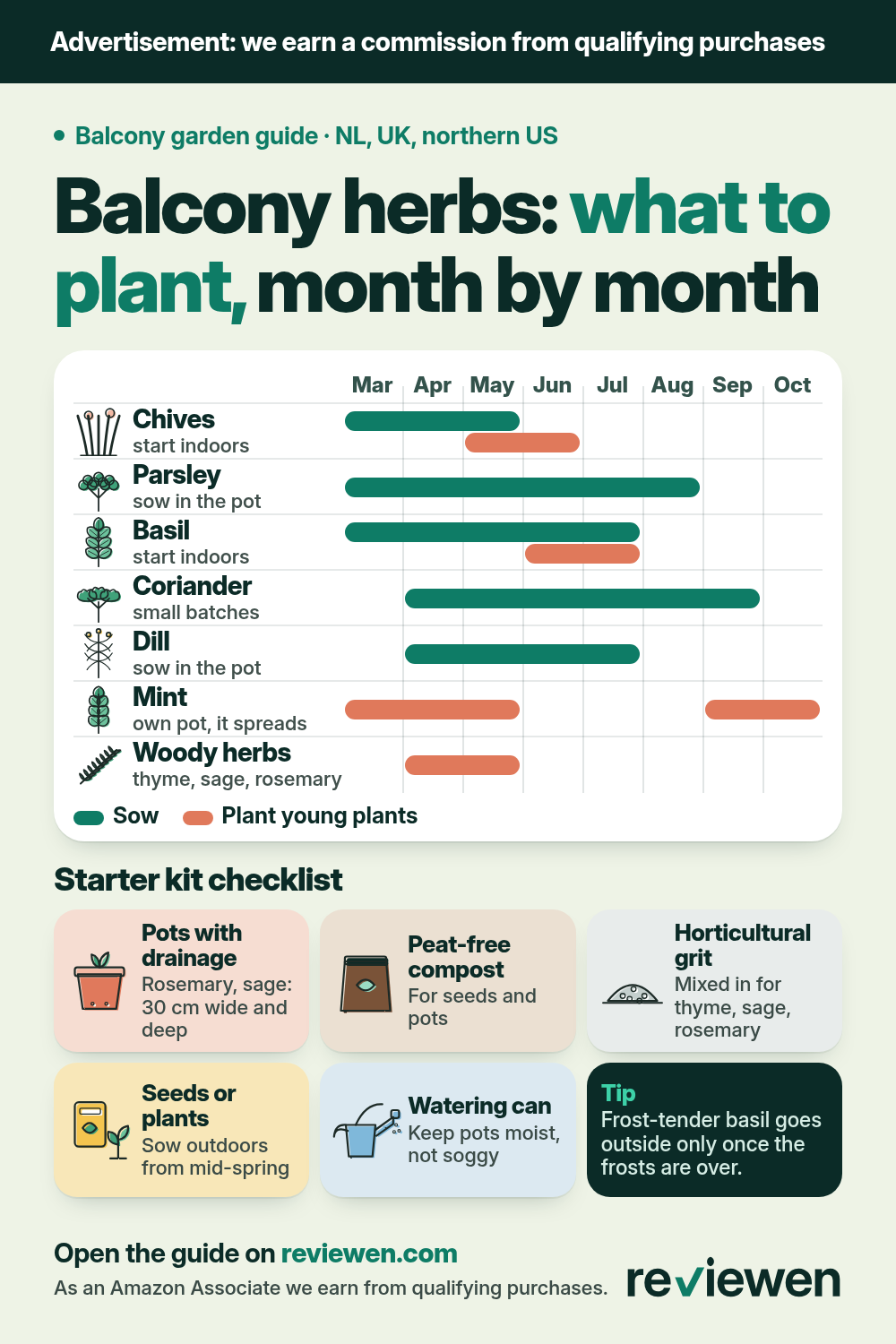
Illustrated timeline from March to October showing when to sow and plant balcony herbs, with a starter-kit checklist.
The whole guide on one image. Open it full size.

About this guide

A balcony is a good place for herbs: they are small, they like pots, and you can reach them while you cook. The trick is timing. Some herbs want an early start indoors, some can be sown straight into the pot, and some are best bought as young plants.

The timeline suits a temperate climate: the Netherlands, the UK and the northern US, where spring is cool and frost can linger. If your balcony is colder, read the frost note below and shift the dates later. The facts come from the Royal Horticultural Society (see Sources).

Balcony basics

  • Sun: thyme, sage, rosemary and basil want a warm, sunny spot. Chives, parsley, mint and dill cope with sun or partial shade.
  • Pots: always with drainage holes. Rosemary and sage need pots at least 30 cm wide and deep.
  • Mint: give it its own pot. It is vigorous and spreads.
  • Water: keep compost moist, never waterlogged. Thyme, sage and rosemary hate wet roots, especially in winter.

Each button opens the Amazon store for your country where we work with it, otherwise the nearest available Amazon store. We don’t show prices; Amazon shows the current price.

Month by month. The text version of the timeline.

Month by month. The text version of the timeline.
HerbSowPlantGood to know
ChivesIndoors from early spring, outdoors in spring (March to May)Plant out in late spring or early summer; harden off first if before JuneSun or partial shade
ParsleyIndoors from early spring; outdoors from mid-spring to late summer, straight into the pot–Sun or partial shade. Pots can come indoors for later harvests.
BasilIndoors from March to JulyPlant out in early summer, once the frosts are overWarm, sheltered spot in full sun. Grown as an annual.
CorianderSpring to autumn, in small batches every few weeks–In summer, sow out of the midday sun to delay flowering.
DillOutdoors from mid-spring to mid-summer–Sun or partial shade
Mint–Spring or autumn (March to May, September to October)Own pot. Most mints are fully hardy.
Thyme, sage, rosemary–Best planted in springFree-draining compost with up to 25% grit. Sunny spot.

Months are for a temperate climate. Colder balcony? Count back from your last frost.

Colder climate? Read this first.

Frost is the thing that decides your dates. These are the rules that matter.

01

Find your last frost date.

Inland areas, higher ground and the colder parts of the northern US get frosts later in spring and earlier in autumn than the coast. Look up the average last-frost date for your area and move every outdoor date after it.

02

Keep basil indoors until the frosts are over.

Basil is tender and needs warmth and sun. Keep young plants indoors until after the last frost, and bring pots in at the end of the season.

03

Harden off indoor-raised plants.

Before planting out chives or other indoor-sown plants, get them used to outdoor conditions over a week or two: a few hours outside at first, then longer.

04

Protect pots in winter.

Plants in containers are more vulnerable to winter cold than plants in the ground. Group the pots together, wrap them in bubble wrap or old blankets, cover rosemary with fleece or hessian in harsh frosts, or move them to a sheltered spot in the lee of a wall.

05

Wet is as bad as cold.

Thyme, sage and rosemary rot in wet winters. Move pots to a sheltered spot such as the rain shadow of a wall. Most widely sold thymes survive frost, but check the plant label.

06

Hardy herbs return.

Chives and mint die back over winter and regrow in spring. Pot up a clump and bring it indoors to a sunny windowsill if you want to keep harvesting.

Starter kit. Five things to get.

Pots with drainage holes

Rosemary and sage need pots at least 30 cm wide and deep. Small herbs are happy in smaller pots.

Peat-free compost

General-purpose peat-free potting compost for seeds and pots.

Horticultural grit

Mix up to a quarter into the compost for thyme, sage and rosemary, so water drains freely.

Seeds or young plants

Sow outdoors from mid-spring, or buy young plants to skip the waiting.

Watering can

A small can with a long spout. Keep pots moist, not soggy.

What to buy. Optional starting points.

Each button opens Amazon for your country, or the nearest available Amazon store. We checked the product name and number on amazon.com and amazon.nl on 29 November 2026. We show no prices; Amazon shows today’s price. Where we could not confirm a product, the button runs a search instead.

vensovo

Terracotta pots with saucers, 4-pack, 15 cm

Four 6 in (15 cm) terracotta pots with saucers. A good size for chives, parsley, basil and dill. Too small for rosemary and sage, which need pots at least 30 cm wide and deep. Check the drainage hole before you buy.

Listing title on Amazon.com: 6 Inch Terracotta & Clay Pots for Plant with Saucer, 4 Pack

Details
ASIN
B083JRHRW1
Checked
29 Nov 2026
Verified on
Amazon.com, Amazon.nl
Price
Not shown here. Amazon shows the current price.
Listing checked 29 Nov 2026

Amazon search

Peat-free potting compost

General-purpose peat-free potting compost for your pots; mix grit in for thyme, sage and rosemary.

Opens an Amazon search for: “peat-free potting compost”

Search link, no listing checked
Search on Amazon (paid link, opens in a new window) Paid link · search on Amazon.com

Amazon search

Horticultural grit

For thyme, sage and rosemary: up to a quarter of the compost can be grit, for free drainage.

Opens an Amazon search for: “horticultural grit”

Search link, no listing checked
Search on Amazon (paid link, opens in a new window) Paid link · search on Amazon.com

Amazon search

Herb seeds or young herb plants

Seed packets for the herbs in the timeline, or young plants if you want to skip the sowing.

Opens an Amazon search for: “herb seeds basil parsley chives coriander dill”

Search link, no listing checked
Search on Amazon (paid link, opens in a new window) Paid link · search on Amazon.com

Amazon search

Watering can for plants

A small can with a long spout reaches pots on a crowded balcony. Water often enough to keep compost moist, never waterlogged.

Opens an Amazon search for: “watering can for plants long spout”

Search link, no listing checked
Search on Amazon (paid link, opens in a new window) Paid link · search on Amazon.com

Questions. Short answers.

Which herbs can share a pot?
Not mint: it is vigorous and spreads, so give it its own pot. Thyme, sage and rosemary like the same sunny, free-draining conditions, but rosemary and sage want a pot at least 30 cm wide and deep, so a mixed pot has to be big.
Should I sow seeds or buy plants?
Basil and chives get a head start sown indoors. Parsley, dill and coriander can be sown straight into the pot. Young plants skip the waiting, which helps if you start late.
Can I grow herbs on a shady balcony?
Mint, chives, parsley and dill cope with partial shade. Basil, thyme, sage and rosemary need warmth and sun.
How often should I water?
Often enough to keep the compost moist, never waterlogged. Thyme, sage and rosemary prefer drier roots, and wet compost in winter can kill them.
Why does the coriander flower so fast?
Coriander bolts in hot, dry weather. Sow small batches often, water in dry spells, and in summer sow it out of the midday sun.

Sources. Where the facts come from.

We read these pages for the timings and care points. The RHS is a UK source; check your local last-frost date. “Once the frosts are over” is general gardening advice for tender basil.

More guides. Keep browsing.