
1. Home
  2. DIY & garden guides
  3. Floating shelf

DIY guide

Install a floating shelf.In 5 steps, safely.

A hidden-bracket floating shelf is an afternoon job. Check the wall first, then follow five steps. Below: the tools list, what you can skip, and a few things to buy.

  • 5 steps
  • 8 tools
  • Listings checked 29 Nov 2026
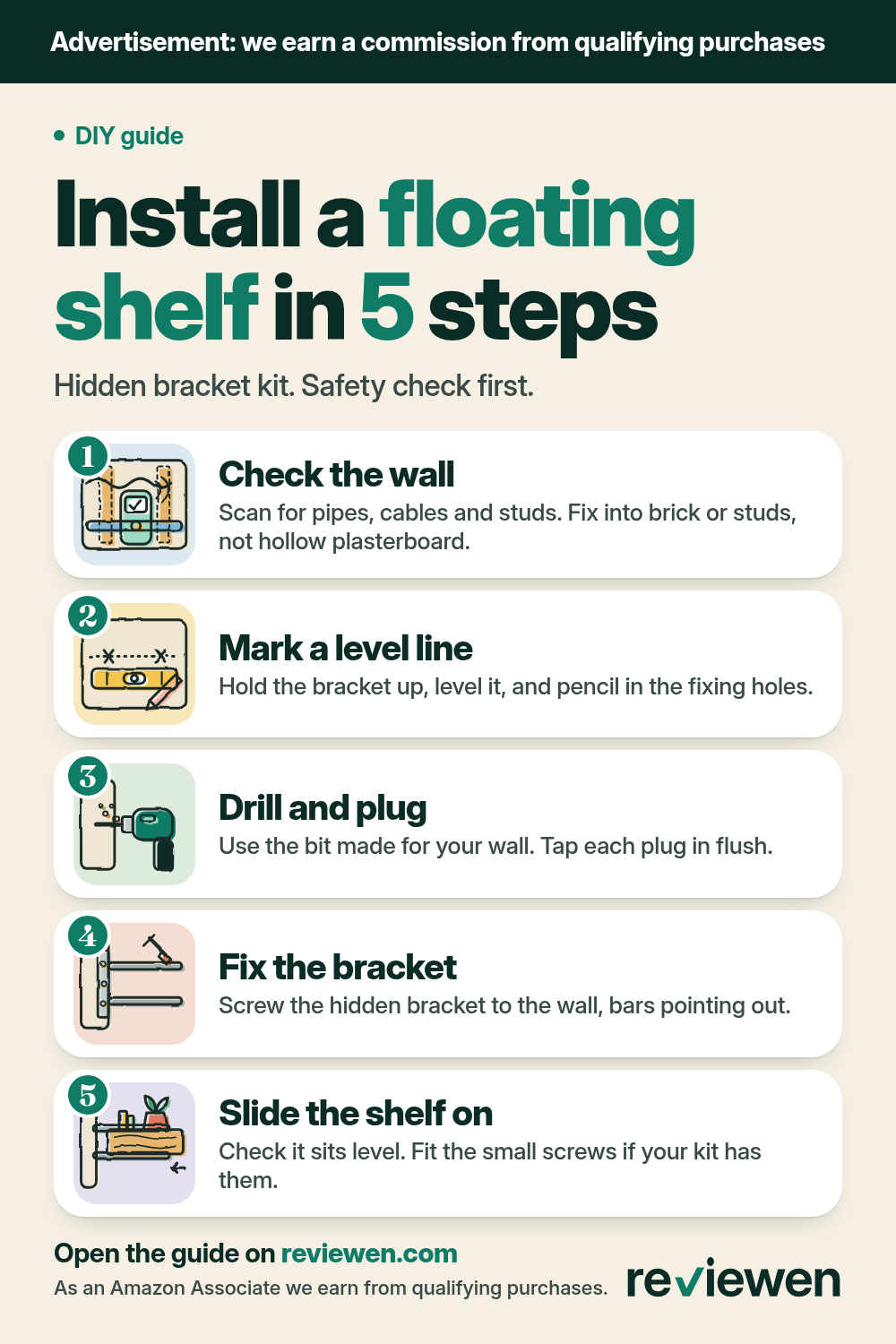
Illustrated infographic with five steps to install a floating shelf: check the wall, mark a level line, drill and plug, fix the bracket, slide the shelf on.
The whole guide on one image. Open it full size.

About this guide

A floating shelf looks like it hangs on nothing. In fact a hidden bracket, usually metal bars fixed into the wall, slides into the back of the shelf. That makes it a good project for a first-time DIYer, as long as you do one thing before you pick up the drill: check what is inside the wall.

This guide follows the fitting instructions of shelf makers and DIY publishers (see Sources). Every kit is a little different, so if the instructions in your box disagree with this page, follow the box.

Before you start

  • Pick the wall first. Brick, block or concrete is easiest. Hollow plasterboard needs studs.
  • Check the load rating of your kit. It depends on the kit, the wall and the number of brackets.
  • Wear safety glasses, and a dust mask when you drill into brick.
  • Allow an afternoon. If your kit uses silicone sealant, it needs a couple of hours to set.

Each button opens the Amazon store for your country where we work with it, otherwise the nearest available Amazon store. We don’t show prices; Amazon shows the current price.

Five steps. Safety first.

  1. Step 1

    Check the wall

    Run a detector over the spot where the shelf will go. You are looking for water pipes, electrical cables and, on a stud wall, the timber studs. If something is in the way, move the shelf. Do not skip this step.

    Tip. On a stud wall, fix into the studs or noggins. Plasterboard fixings alone only suit light, shallow shelves.

  2. Step 2

    Mark a level line

    Hold the bracket (or the shelf, with its pre-drilled holes facing up) against the wall at the height you want. Check it with the spirit level and pencil in the fixing holes. Check once more that the marks are level and match the holes in the shelf.

    Tip. Put masking tape over the marks before drilling plasterboard. It helps stop the plaster from cracking.

  3. Step 3

    Drill and plug

    Use the bit made for your wall: a masonry bit for brick, block or stone, a wood bit for studs. Use the diameter your kit asks for (many kits use 10 mm) and drill as deep as the plug is long. Tap each plug in until it sits flush. A plug that sticks out stops the shelf from sitting flat.

    Tip. Wrap a piece of tape round the drill bit at the depth you need, so you do not drill too deep.

  4. Step 4

    Fix the bracket

    Screw the hidden bracket or bars into the plugs, with the bars pointing out. If your kit lets you level the shelf by adjusting the bars, do not tighten them fully yet. Use the spanner or screwdriver your kit asks for.

  5. Step 5

    Slide the shelf on

    Slide the shelf onto the bars (an arrow or label usually marks the top side). Put the spirit level on it and adjust. Push the shelf flush to the wall, then fit the small screws on the underside, or add a little silicone sealant, if your kit says so.

Which wall? It decides the fixing.

Which wall? It decides the fixing.
WallHow to recognise itWhat to do
Solid brick, block, stone or concreteKnocks dull and solid. Drilling takes a while.Masonry bit and wall plugs. The easiest wall for a floating shelf.
Stud wall (plasterboard on timber studs)Sounds hollow. The detector finds the studs.Fix into the studs or noggins with the right bit. If you cannot find them, choose a different type of shelf.
Plasterboard onlySounds hollow, no stud nearby.Drywall anchors suit light, shallow shelves only. Heavy loads need studs or another fixing.

Always follow the instructions that come with your shelf.

Tools and materials. What to skip.

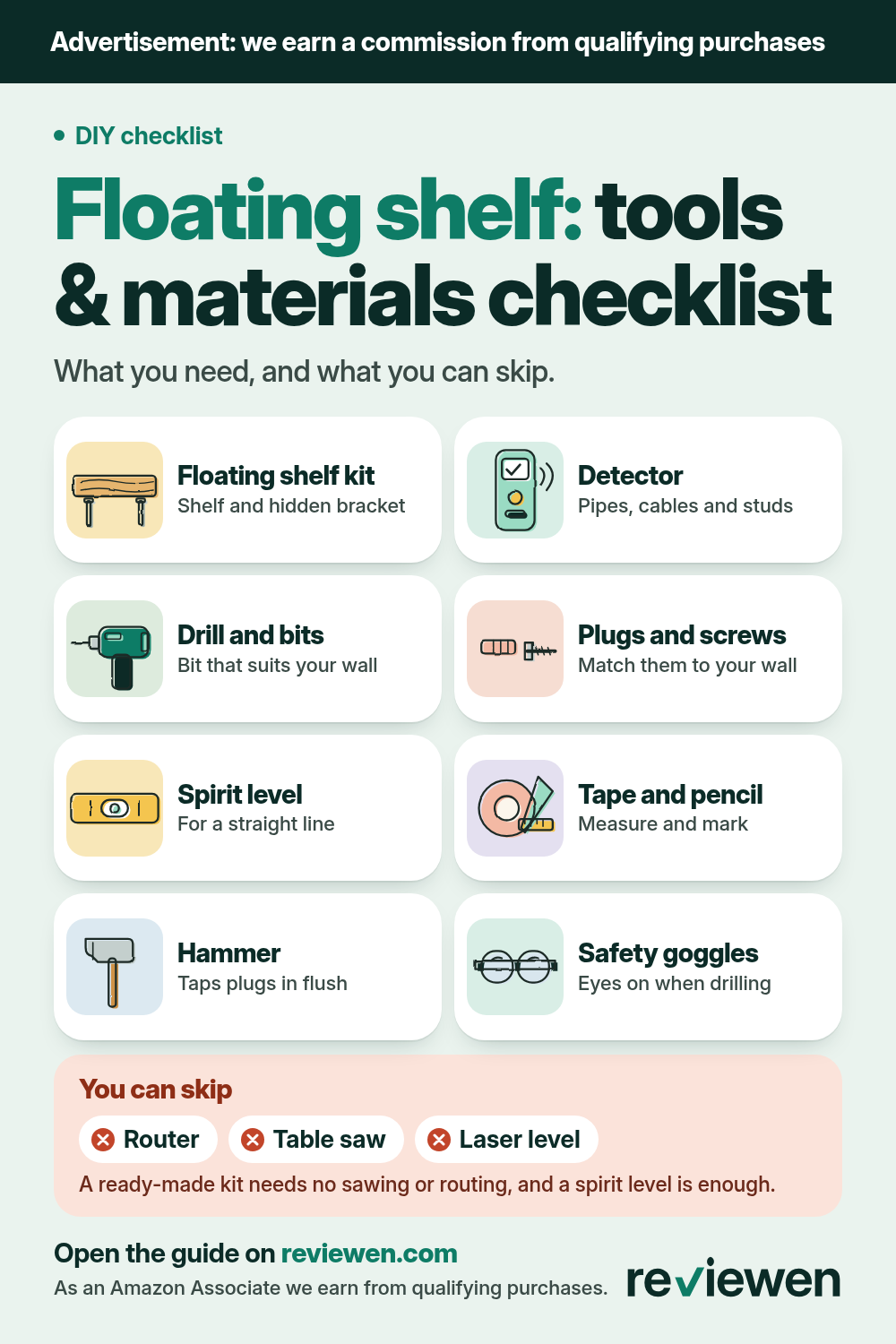
Illustrated checklist of eight tools and materials for hanging a floating shelf, with a list of tools you can skip.

Eight things on the list, and three you can leave in the shed.

You need

  • Floating shelf kit with hidden bracket
  • Detector for pipes, cables and studs
  • Drill and bits that suit your wall
  • Plugs and screws that match your wall
  • Spirit level
  • Tape measure and pencil
  • Hammer to tap the plugs in flush
  • Safety glasses

You can skip

  • Router
  • Table saw
  • Laser level

A ready-made kit needs no sawing or routing, and a spirit level is enough.

What to buy. Optional starting points.

Each button opens Amazon for your country, or the nearest available Amazon store. We checked the product names and numbers on amazon.com and amazon.nl on 29 November 2026. We show no prices; Amazon shows today’s price. Where we could not confirm a product, the button runs a search instead.

Amazon search

Floating shelf with hidden bracket

The shelf itself. Pick a kit that lists its load rating and says which wall types it suits.

Opens an Amazon search for: “floating shelf hidden bracket kit”

Search link, no listing checked
Search on Amazon (paid link, opens in a new window) Paid link · search on Amazon.com

Bosch Professional

GMS 120-27

Finds cables, pipes and studs before you drill. The listing gives detection depths of 120 mm for non-magnetic metal, 100 mm for magnetic metal, 50 mm for live cables and 30 mm for wood.

Listing title on Amazon.com: Bosch Professional GMS 120-27 Detector (2 x AA Batteries, Max. Detection Depth Non-Magnetic Metal/Magnetic Metal/Voltage-Conducting Cable/Wood: 120/100/50/30 mm, Protective Bag)

Details
ASIN
B0D94P43WT
Checked
29 Nov 2026
Verified on
Amazon.com, Amazon.nl
Price
Not shown here. Amazon shows the current price.
Listing checked 29 Nov 2026

Stabila

Type 196-2, 61 cm

A 61 cm aluminium spirit level with one horizontal and two vertical vials. Long enough to draw the line and to check the shelf.

Listing title on Amazon.com: STABILA Type 196-2 Spirit Level, 61 cm, Extra Rigid Aluminium Profile, 1 Horizontal Levels, 2 Vertical Levels, 2 Handles, Shock-Absorbing End Caps, Integrated Slip Stopper, Made in Germany

Details
ASIN
B0001P0TJG
Checked
29 Nov 2026
Verified on
Amazon.com, Amazon.nl
Price
Not shown here. Amazon shows the current price.
Listing checked 29 Nov 2026

Stanley

PowerLock 0-33-191, 5 m

A 5 m x 19 mm locking tape measure with a metric scale. Enough for spacing the fixing holes and the height.

Listing title on Amazon.com: 0-33-191 Stanley Powerlock Tape 5 M

Details
ASIN
B00T9PSTP0
Checked
29 Nov 2026
Verified on
Amazon.com, Amazon.nl
Price
Not shown here. Amazon shows the current price.
Listing checked 29 Nov 2026

Amazon search

Cordless drill/driver

Any cordless drill/driver with a bit set that includes masonry and wood bits will do.

Opens an Amazon search for: “cordless drill driver with drill bit set”

Search link, no listing checked
Search on Amazon (paid link, opens in a new window) Paid link · search on Amazon.com

Amazon search

Wall plugs and screws assortment

Match the plugs to your wall: universal plugs for solid walls, drywall anchors only for light loads.

Opens an Amazon search for: “wall plugs and screws assortment”

Search link, no listing checked
Search on Amazon (paid link, opens in a new window) Paid link · search on Amazon.com

3M

Virtua 71500-00001

Clear safety glasses. The listing mentions an anti-scratch coating and UV protection. Put them on before you drill.

Listing title on Amazon.com: 3M Virtua AP Safety Glasses

Details
ASIN
B0044ENP46
Checked
29 Nov 2026
Verified on
Amazon.com, Amazon.nl
Price
Not shown here. Amazon shows the current price.
Listing checked 29 Nov 2026

Questions. Short answers.

How much weight can a floating shelf hold?
It depends on the kit, the wall and the number of brackets. As one example, a UK maker rates its concealed brackets at up to 35 kg across two brackets, including the shelf, when fixed into a solid wall. Check the rating of your own kit and do not guess.
Can I put a floating shelf on plasterboard?
Only if you can fix into timber studs or noggins behind it. Light, shallow shelves can use proper plasterboard fixings, but the safest method is to use the studs.
Do I need a detector?
Yes, we would not skip it. A detector that finds cables and pipes as well as studs tells you where it is safe to drill. A detector that only finds studs is not enough.
Can I hang a floating shelf without drilling?
Not really. Adhesive solutions only hold very light items, and a floating shelf tends to lean if its support is not firmly fixed. Hidden-bracket shelves need drilling.
What if I rent?
Check your lease first. If you drill, fill the holes and paint over them when you leave.

Sources. Where the facts come from.

We read these pages for the method and the safety points. Nothing is copied. We have not tested every product on this page.

More guides. Keep browsing.